
Lance Lakehouse Format Specifications
Lance is a lakehouse format defined as a stack of interoperating specifications, rather than as a single file format or metadata layout. The storage-facing layers cover files, tables, indices, and catalogs. A unified namespace interface sits above those layers and gives engines a consistent way to work with Lance tables across catalog implementations.
Architecture Overview
Modern lakehouses are built from complementary layers. Lance keeps those layers intentionally decoupled so that the file format, table metadata, indices, and catalogs can evolve independently without forcing lock-in across the stack.
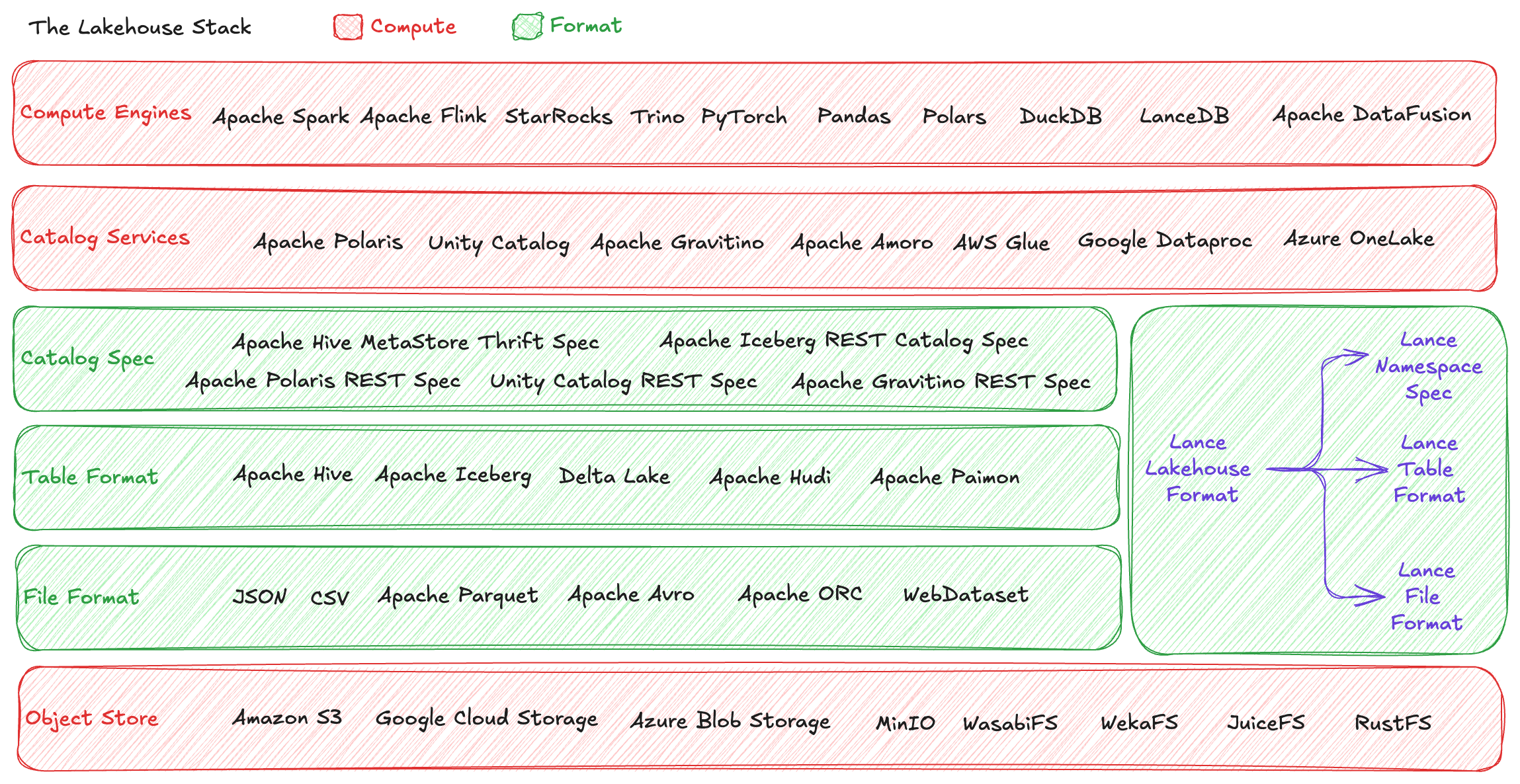
At a high level:
- The file format stores column data in large pages optimized for random access and avoids row groups.
- The table format manages fragments, manifests, deletions, schema evolution, and ACID commits.
- The index formats define redundant search structures such as scalar, vector, full-text, and system indices.
- The catalog specs define how tables are discovered, registered, and coordinated across engines and services.
- The namespace client spec provides a unified interface for engines to interact with any catalog implementations.
The layers are designed so that only table readers, table writers, and index readers or writers need to understand the on-disk Lance file layout.
Design Themes
File Format
The Lance file format is optimized for cloud object storage and highly selective reads. It avoids Parquet-style row groups, uses structural encodings for efficient random access, and keeps statistics and search structures out of the file format so those concerns can evolve independently as indices.
Table Format
The Lance table format organizes data in two dimensions: rows are grouped into fragments, and each fragment can contain multiple data files, each contributing a subset of columns. This makes column additions and backfills primarily metadata operations instead of data rewrites, which is especially useful for feature engineering and embedding workflows.
Index Formats
Indices are first-class table objects. Lance tables define how indices are discovered, versioned, and coordinated transactionally. The index formats themselves remain decoupled from both the file encoding and the table manifest structure.
Catalog Specs
Lance provides both storage-native and service-oriented catalog options. The Directory Catalog supports zero-infrastructure deployments directly on object stores, while the REST Catalog standardizes enterprise-facing APIs and can act as an external manifest store.
Namespace Client Spec
The Namespace Client Spec provides a language-agnostic interface for engines to interact with any catalog implementation, including Lance-native catalogs and third-party catalog systems. This abstraction allows applications to switch between directory-based, REST-based, and third-party catalogs without changing their code.
Specifications
The main specification entry points are:
- File Format: Lance file format
- Table Format: Lance table format
- Index Formats: Scalar, vector, and system index formats
- Catalog Specs: Directory and REST catalog specs
- Namespace Client Spec: Lance namespace interface